Quick answer
A business emergency grab bag holds what you need to keep operating and to claim help if your premises are lost: printed key contacts, insurance policy schedules, ABN and ABR details, bank and account access information stored securely, a USB copy of key records, lease and asset lists, and basic supplies such as a torch, radio and first-aid kit. Keep a digital copy in the cloud and review it before storm and bushfire season.
Key points
- Keep two copies: a physical grab bag and a secure cloud folder.
- Contacts and policy numbers matter more than anything else on day one.
- Keep your ABR address current with a street address to help prove eligibility for assistance.
- Review the kit every year before storm and bushfire season.
Most business owners have a plan for the till, the stock and the staff roster. Very few have a plan for the moment they’re standing in a car park with nothing but a phone, watching the premises burn or fill with water.
In that moment, the things that matter are surprisingly small: a policy number, a phone list, a copy of the lease, a way into the bank account. This guide is about packing them before you need them — the business version of the emergency kit many households already keep.
It takes about twenty minutes to assemble the first version. It can save weeks of rebuilding records and chasing paperwork during a recovery.
Why does a business need a grab bag?
After any serious event, three things happen at once:
- You need to contact people — insurer, staff, customers, suppliers, the bank.
- You need to prove things — what you owned, where you traded, what you’re insured for, that you’re eligible for help.
- You need to keep operating — pay people, answer phones, take orders from somewhere else.
All three depend on information that usually lives in a filing cabinet or on a computer in the very building you’ve just lost. business.gov.au’s preparation guidance makes the point directly: protect registration records, financial statements and customer information, and keep key documents and phone numbers in an emergency kit that’s accessible and visible.
What should go in the physical grab bag?
Keep this in a waterproof bag or case near an exit, plus a copy at home or another site.
Contacts (printed)
- Insurer claims line and your policy numbers
- Your insurance broker, if you have one
- Bank relationship manager and fraud line
- Accountant or bookkeeper
- Landlord or property manager
- Electrician, plumber, locksmith, IT provider
- Key suppliers and key customers
- Every staff member’s mobile and an emergency contact
- ATO Emergency Support Infoline — 1800 806 218
- business.gov.au — 13 28 46
- Small Business Debt Helpline — 1800 413 828
Our recovery contacts by state page is designed to be printed and added.
Documents (copies)
- Insurance policy schedules (the pages listing what’s covered and for how much)
- ABN, ACN and business name registration details
- Lease or property title details
- Asset and equipment list with serial numbers, purchase dates and photos
- Finance agreements for vehicles and equipment
- Most recent BAS, tax return and financial statements
- A list of the software and online services you use
Supplies
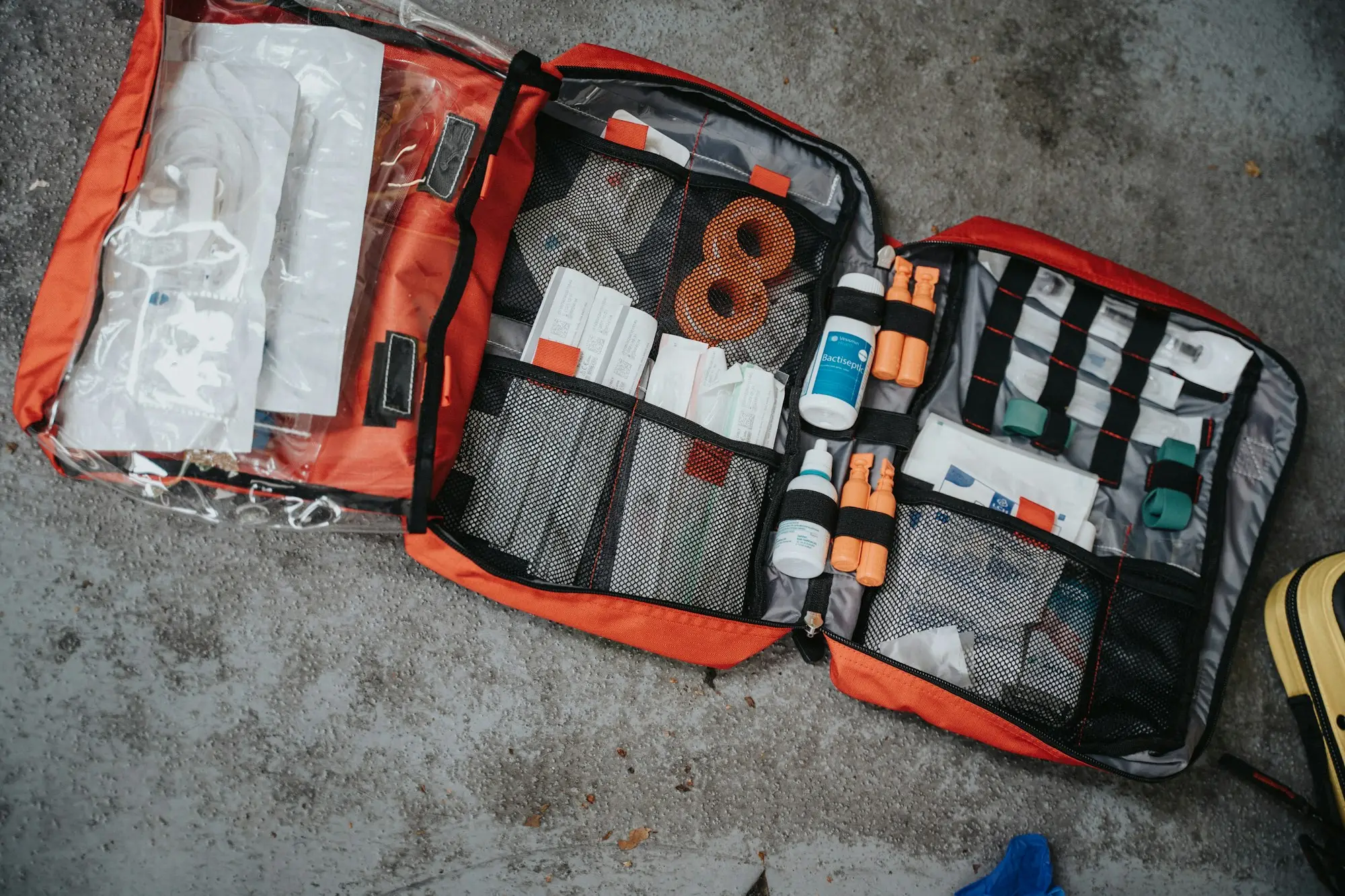
business.gov.au suggests including a torch, first-aid kit, portable radio, waterproof bags, hand sanitiser or wipes, bottled water and spare batteries. Add a phone power bank, a notebook and pens, and a few printed copies of your “we’ve moved temporarily” sign.
What belongs in the digital kit?
The physical bag gets you through the first day. The digital kit gets you through the next three months.
| Item | Where to keep it |
|---|---|
| Scans of every document above | Secure cloud folder shared with a trusted second person |
| Accounting data | Cloud accounting software, or regular exports stored off-site |
| Customer and supplier lists | Exported monthly |
| Photos and video of premises, stock and equipment | Cloud folder, updated each year |
| Staff records and payroll | Payroll software with off-site backup |
| Passwords | Business password manager with emergency access for a trusted person |
business.gov.au recommends backing up digital records regularly to the cloud or to a drive stored securely away from the main premises, and notes that fireproof safes have limits for digital media.
A word on passwords: never keep them in a plain document or on paper in the grab bag. A password manager with an emergency access feature is safer, and if a cyber attack is part of the crisis, you’ll want to know no one else can read your list.
Which records prove you’re eligible for disaster help?
Government assistance is tied to where you were trading when the event happened. Keep proof handy:
- Your Australian Business Register record — business.gov.au specifically advises keeping ABR details current with your actual street address, not a PO box, so you’re eligible for emergency assistance.
- A rates notice, lease or utility bill for the premises
- Recent BAS showing you were trading
- Bank statements showing normal activity
If you ever need to apply for a recovery grant or concessional loan, these are among the first things you’ll be asked for. More on that in finding disaster help.
What about records you’ve already lost?
If the worst has already happened, don’t panic. Much of it can be rebuilt:
- The ATO says it may be able to provide replacements for lost or damaged tax records — call 1800 806 218 after a natural disaster.
- Your bank can provide statement history.
- Accounting and payroll software keep records in the cloud.
- Suppliers can resend invoices; customers can confirm balances.
- Your insurer or broker can provide policy documents.
It’s slower than having them ready, which is the whole point of the grab bag.
How does the grab bag fit with your emergency plan?
The grab bag is the “stuff”. Your emergency plan is the “who does what”. business.gov.au describes an emergency management plan in three parts: a continuity plan (critical areas, key customers, insurance, backups), an emergency action plan (contacts, evacuation, emergency team roles) and a recovery plan (assessing damage, recovery partners, insurance claims, reopening).
Our one-page business continuity plan guide gives you a simple template, and our emergency action checklist shows what you’ll need for each type of event.
Where does money fit into preparation?
Being prepared doesn’t mean you’ll never need funding in a crisis. It means that when you do, you can move quickly. A lender assessing an emergency application will usually want:
- recent business bank statements
- ABN or ACN and ID
- details of any property you might use as security
- insurance policy and claim details
- quotes for what needs paying
Keeping these in the digital kit means a funding decision can happen in days rather than weeks. If you ever reach that point, our enquiry form takes about a minute, and there’s no credit check when you first enquire.
How do you keep the kit current?
Set a calendar reminder for early spring — before bushfire, storm and cyclone season in most of Australia — and run through this list:
| Check | Done |
|---|---|
| Contacts still correct (especially staff mobiles) | |
| Insurance schedules are this year’s | |
| Asset list includes anything bought this year | |
| Photos of premises and stock updated | |
| Cloud backups working (test a restore) | |
| ABR address correct | |
| Supplies (batteries, water) replaced | |
| Second person knows where everything is |
The last line matters. If you’re away or injured, someone else needs to be able to use the kit.
What’s a sensible first step today?
Don’t try to do everything at once. Today, do three things:
- Print your insurance schedules and put them in a waterproof sleeve.
- Write a one-page contact list and put it with the schedules.
- Check your ABR address on the Australian Business Register.
Next week, set up the cloud folder. The week after, photograph the premises and equipment. In a month, you’ll have a kit most businesses never get around to.
If a crisis has already arrived
If you’re reading this after the event rather than before, start with the emergency action checklist. And if insurance, grants and hardship arrangements won’t close the gap in time, talk to us.
You’ll speak with an actual person who has your details in front of them. Asking what’s possible costs nothing and leaves your credit file exactly as it is. We don’t farm out enquiries — one team holds your file from start to finish.
The more precise you are about the amount, the purpose, your state and any property, the less time we spend going back and forth. Start your enquiry here.
Frequently asked questions
What documents should a business keep in an emergency kit?
Insurance policy schedules and claim contacts, ABN and company details, lease, asset and equipment lists with serial numbers, key supplier and customer contacts, recent BAS and financial statements, and a list of bank and software logins stored securely rather than written in plain text.
What supplies does business.gov.au suggest for an emergency kit?
Its preparation guidance lists key documents (printed or on a USB drive), phone numbers, a torch, first-aid kit, portable radio, waterproof bags, hand sanitiser or wipes, bottled water and spare batteries, kept somewhere accessible and visible.
Is it safe to keep passwords in the kit?
Don't write passwords in plain text. Use a business password manager with emergency access for a trusted person, and keep only the recovery information needed to get into it.
Where should the kit be kept?
Somewhere you can grab it in minutes, plus a copy off-site. business.gov.au recommends backing up digital records to the cloud or to a drive stored securely away from your main premises.
How often should I update it?
At least once a year, and whenever you change insurer, bank, key suppliers, premises or staff. Before storm and bushfire season is a good habit.